The Writing Process
Or How I Don’t Think About It

Every once in a while, I get questions about my “writing process.” Quite frankly, I don’t believe that there’s a catch-all writing process that works for everyone. Everyone has their own thing that works for them, and that’s the way it should be. Sure, there are some broad stroke advice bits that could generally apply to all writers, but I’ve always been a big advocate of “do what works for you.” As it is, I write lots of different things, so my process has always been variable. But since I’m a good sport, I’ll try to answer as best as I can.
Journalism: When I write a story for The Saturday Evening Post, I frequently traffic in history or pop culture. That means I generally get an idea first and then build something around it. A few weeks back was the fiftieth anniversary of the commencement of filming on Star Wars. Knowing a lot about the history of the production, including difficulties with the studio, problems on the set, and so on, it hit me that I could make the piece about other “troubled” productions that observers and prognosticators thought would fail, only for them to be classic, monster hits. That was pretty easy: get one idea, push and pull at it a little bit, build on it, and bam, there’s your piece. I decided to not say that the last movie in the piece was Star Wars right up until the end basically just to amuse myself.
If I do something historical or political, that always entails a lot of reading. I’ve written a fair amount about constitutional amendments for the Post, and those pieces always begin with me reading and re-reading the specific amendments themselves. You aren’t doing anyone any favors in writing about history if you don’t read more than one source. And despite what people told you 15 years ago, Wikipedia is not a bad place to start. That’s because over time, Wikipedia has been vigorously sourced, and it’s a great place to find links to primary sources (newspaper article, magazine pieces, etc.) that you can use and quote in your work. It’s always great when you can get quotes for experts, but that’s occasionally very difficult on certain timetables. When you have time for something to breathe, it’s much easier to track someone down, schedule a talk and get them on the record. It wasn’t hard news, but I did a piece on Night of the Living Dead once with enough lead time that allowed me to interview both John A. Russo (co-writer of the film) and Judith O’Dea (who played Barbara); that elevated anything I could have written alone into something much better.
Non-Fiction: Research, research, research, and try to not to fuck up. See Marvel Comics for Dummies and X-Men for Dummies.
Comics: Comics are a weird duck. Comics are an intensely collaborative medium, so you rarely have an a-to-b-to-c writing process. If you’re doing stuff for another company, you have lots of input from editorial and you may have to stick to the rules and continuity of a larger universe. When Matt Brady and I wrote Batman for DC, we got a list of very specific rules regarding the writing of the character. When I started writing Grimm Fairy Tales Myths and Legends for Zenescope, Raven Gregory basically said do what you want, and we’ll tell you if it needs changed. I actually had a ton of creative freedom on the first portion of Blood Queen for Dynamite; every detail of the kingdoms, the character backstories, and the way that magic worked was all me. But nothing trumps the creative freedom of Sparkshooter. While stuff there is definitely inspired by real-life things, the story is all mine and brought to life by some seriously talented artists.
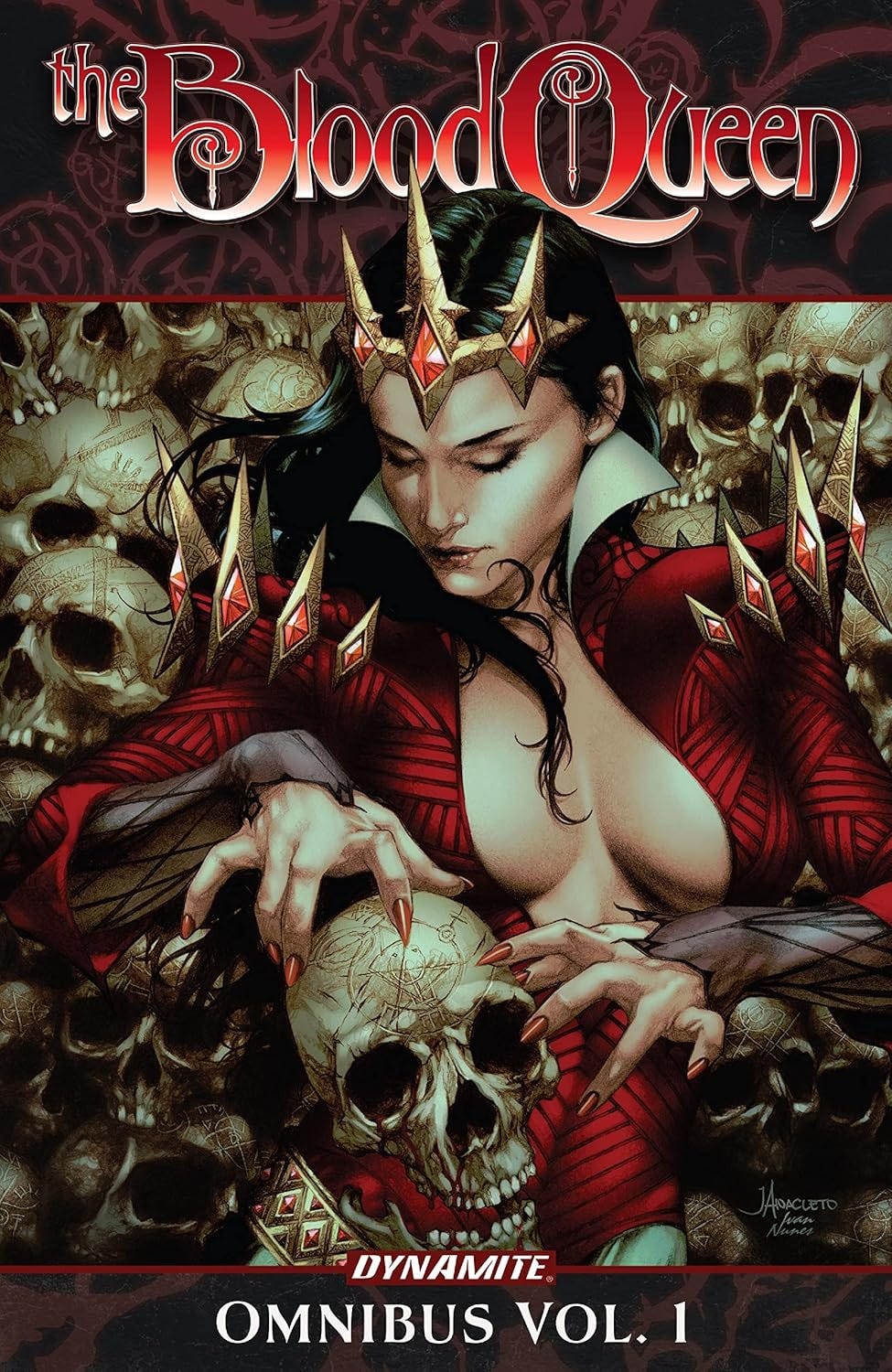
In terms of plotting, I tend to just write a couple of paragraphs outlining the main idea. Then I got through that and break it up into pages. Say there’s an opening fight. Maybe I give that four pages out of the standard 22. I need to figure out how to pace the rest of the issue to keep things moving, or maybe I make the fight bigger for more bang in the opening. In Blood Queen vs. Dracula #1, I went for a big opening with Dracula taking on Ottoman invaders, and then moved into a more dialogue-heavy, plot-building scene. But I usually try to figure that out ahead of time so I don’t come up short or have too much in terms of page count. I’m a full-script guy, so after I figure out the breakdown of pages, I write the full script with dialogue, etc.
Short Stories: I’m kind of old school Poe-ish on most of those. My short stories are usually one central idea. I recently posted “Hell is for Children” here from my short story collection, Inhabited. My one central idea for that story was that a teacher had to keep reliving a series of hellish incidents from their career but as if they happened all in one day. I’m a big believer in the idea that you can draw inspiration from almost anywhere; this story in particular came from own experiences as a teacher. While I’ve never been involved in an active shooter situation, I have done many drills as a teacher and found it quite traumatizing that my kids started getting trained to deal with that shit in kindergarten. That, and some of the other things that I’ve seen (abused students, students being solicited for hook-ups from another teacher, etc.) all rolled into the idea for the story.
Another story from Inhabited, “The Ongoing Problem of Haunted House Bedtime,” came from the fact that tiny Kyle had a run of being scared and wanting to sleep with Connor. Connor (still kind of tiny himself) was generally okay with that, but I could tell he wanted his own space. That gave me the idea that “what if there WAS a monster under Kyle’s bed, and Connor decided to get rid of it so he could have his bed to himself?” That was it. I think I wrote that story almost entirely in one setting and it remains one of my own favorites of my stuff.
Novels: I go in here with a Big Idea. I write a few paragraphs about the Big Idea and what I hope to accomplish. I go back over those paragraphs and start to put in chapter breaks. I DO NOT use a traditional outline because I don’t want to handcuff myself. When I start finding chapter breaks, I start a new doc that has each chapter described in a few sentences. Basically, it’s who does what and why. I will often move those around as I go.
During the actual writing, I go back and correct and edit over and over. I will adjust stuff in the earlier text to fit in ideas that I have later. Like lay in a mention of a person or a place sooner in the story so that it’s tighter overall down the road. And there is always time for digressions to amuse myself; in Prince Dracula, I had a scene that discussed the American cowboy fad that was popular in London following the Buffalo Bill Wild West Show touring there, and tied it to Quincy Harker and the fact that the Jack the Ripper investigation briefly looked at least one American. That kind of weird stuff is totally my shit. In my upcoming novel, I have more than one mention of “Missing White Woman Syndrome,” wherein pretty blondes who disappear get disproportionately larger news coverage than non-white women, particularly Indigenous women, who disappear at a shockingly high rate.
So What?: So, that’s how I sort of look at each major area. But the truth is . . . I try not to think about it. I’ve always felt better writing when I’m guided by instinct and not outlines. Sometimes it’s necessary, like the Dummies books, but I am absolutely NOT making that up as I go along. There are whole sequences, some important, in the new novel that weren’t in the “outline,” but occurred to me as a I was going along. On the other hand, a major turning point in the middle of the book was there from the beginning, and written almost exactly as I had imagined it from the start. You never can tell, really. You have to be prepared to surrender to the flow and not fight it for the sake of notes you made. If there’s one thing I want to leave you with, it’s this notion: however you do it that feels right for you . . . that’s the right way.